New Feature: Compare Your Writing to the Classics
Ever wonder how your parse prose stacks up against Hemingway's? Whether your sentences are shorter than Melville's? If your vocabulary is as varied as Poe's?
Now you can find out. Introducing Text Comparison, a new feature that lets you compare any analyzed text against books in our Classics Library.
How It Works
From any analysis page, click the "Compare" button to pick a reference text. You'll get a side-by-side breakdown across four dimensions of writing.
What You'll See
Overview Dashboard
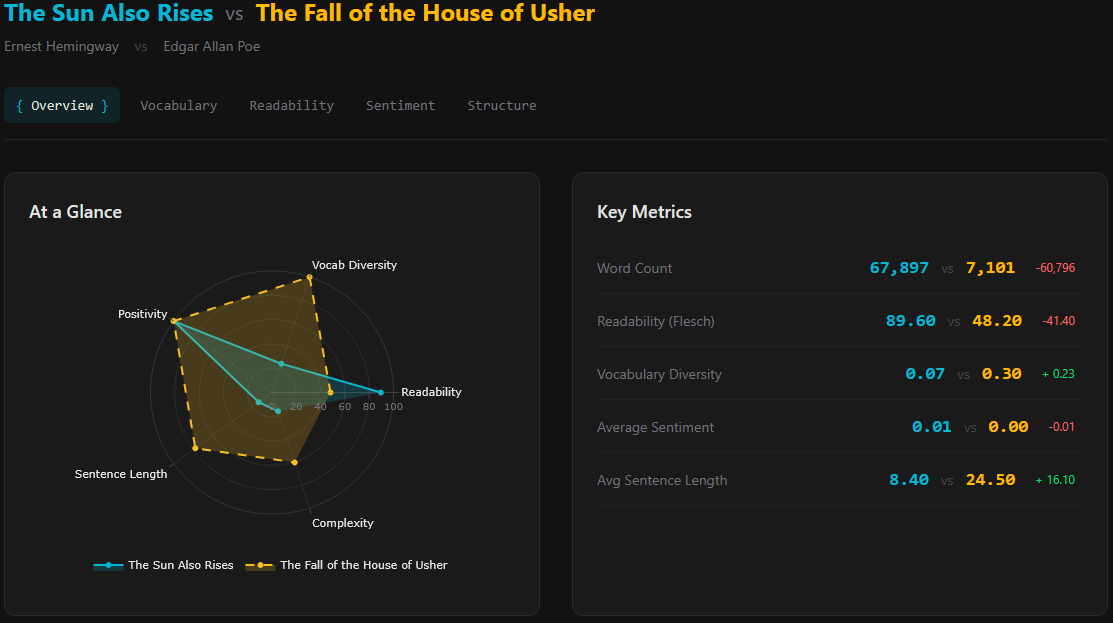
The comparison opens with two things: a radar chart overlaying five normalized metrics on a polar plot, and a Key Metrics panel showing word count, readability, vocabulary diversity, sentiment, and sentence length side by side. Color-coded difference badges make it easy to spot where each text leads.
Vocabulary Deep Dive
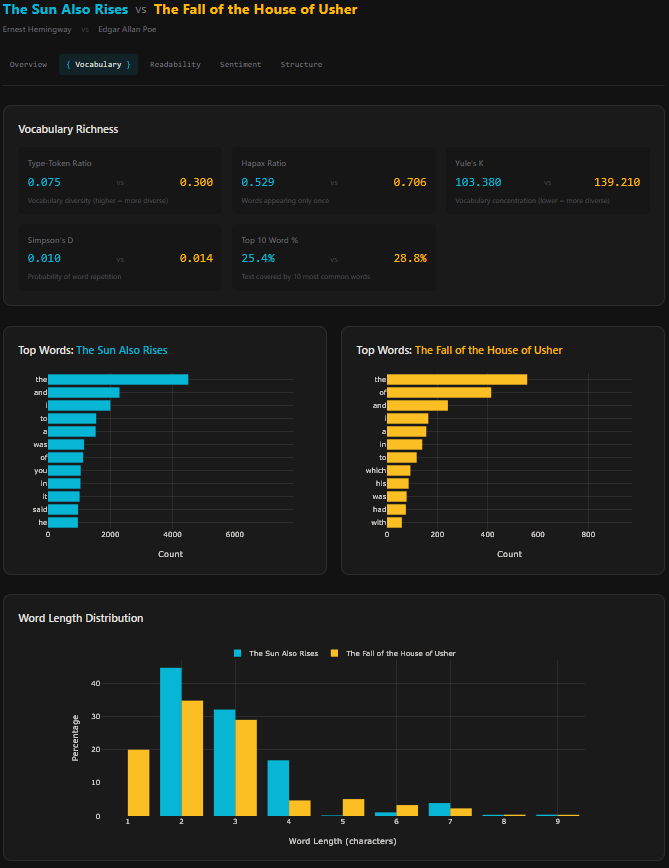
How diverse is your word choice compared to a published author? The vocabulary tab compares Type-Token Ratio, Hapax Ratio, Yule's K, Simpson's D, and Top 10 Word % between texts. You'll also see side-by-side bar charts of the 12 most frequent words and a grouped word length distribution chart.
Readability Deep Dive
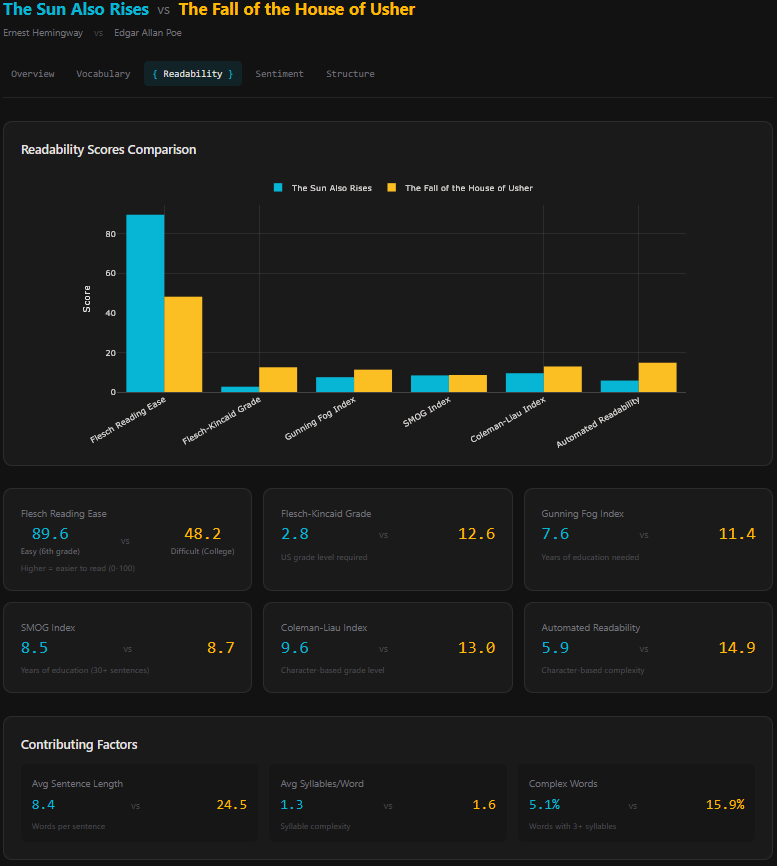
All six readability formulas, Flesch Reading Ease, Flesch-Kincaid Grade, Gunning Fog, SMOG, Coleman-Liau, and ARI, compared in a single grouped bar chart. Below that, contributing factors like average sentence length, syllables per word, and complex word percentage show why the scores differ.
Sentiment Deep Dive
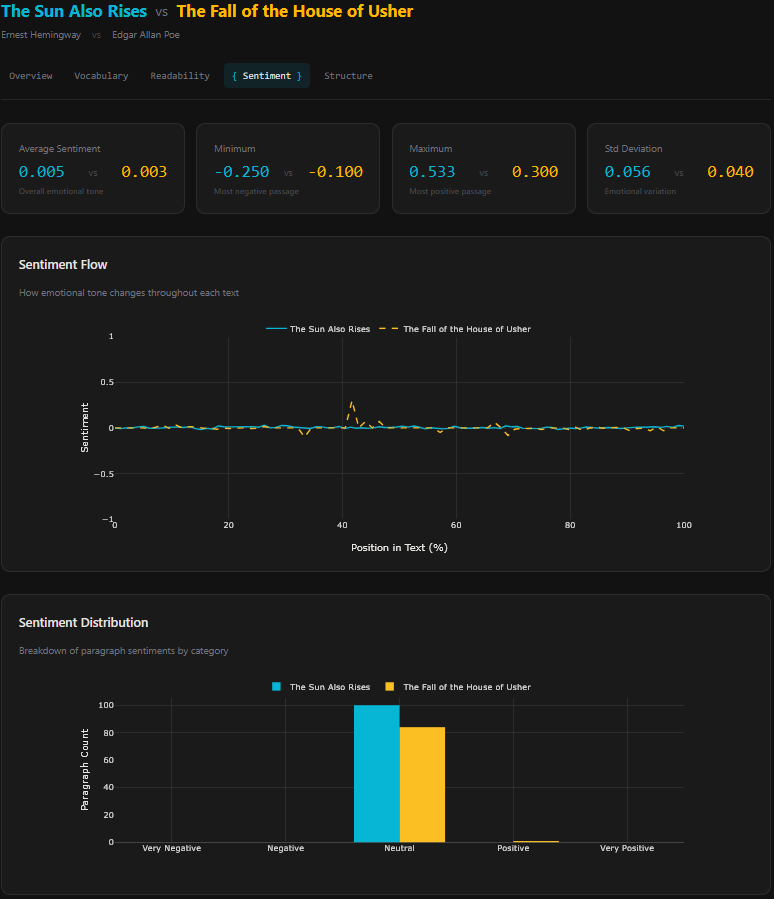
Two line charts overlaid on the same axis show how emotional tone flows through each text. A sentiment distribution histogram reveals whether a text skews positive, negative, or neutral. Summary cards break down average, min, max, and standard deviation of sentiment.
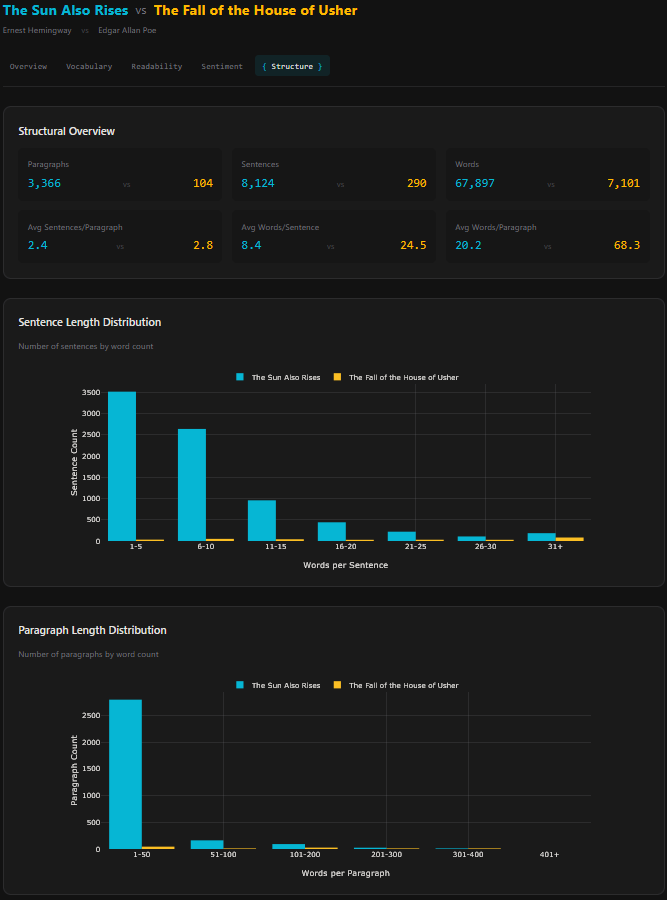
Structure Deep Dive
Compare paragraph counts, sentence counts, and averages side by side. Grouped histograms show how sentence lengths and paragraph lengths are distributed across both texts, useful for spotting differences in pacing and rhythm.
Why It Matters
Raw metrics are useful, but they're more meaningful in context. Knowing your Flesch score is 62 tells you something. Knowing it's 62 while Dune scores 80 tells you a lot more.
Comparison turns numbers into insights. It begins to answer the question every writer eventually asks: How does my writing actually compare?
Try It Now
Head to any analysis page, whether it's a book from the Classics Library or your own scanned text, and click "Compare" to get started.
Want to analyze your own writing?
Discover your verbal fingerprints with Prose Parser.
Analyze Your Text